How to Tell If a Candidate Can Actually Perform—not Just Interview Well
October 20, 2026
Accountability vs. Personality: What Should You Really Look for When Hiring?
There is a moment after a great interview when hiring can become surprisingly emotional.
The candidate was easy to talk to. They understood your sense of humor. The conversation flowed naturally. They seemed enthusiastic about the firm, connected well with the team, and gave you the feeling that they would “fit right in.”
You leave the interview thinking:
I really like this person.
That matters. No law firm owner wants to spend 40 hours a week with someone who makes collaboration unnecessarily difficult.
But there is an important question to ask before turning that positive impression into a job offer:
Do you like this candidate—or do you have evidence that you can rely on them?
Those aren’t the same thing.
As law firms grow, hiring decisions increasingly affect more than workplace chemistry. Every new employee influences capacity, client experience, profitability, workflow, and the amount of management attention required from attorneys and leadership.
Personality may make someone enjoyable to work with.
Accountability is what makes it possible to trust them with responsibility.
Personality Matters. It Just Shouldn’t Carry the Hiring Decision.
Let’s make one thing clear: personality isn’t irrelevant.
Communication style, professionalism, emotional intelligence, adaptability, and the ability to work effectively with others can all contribute to a healthy law firm culture. A technically capable employee who consistently creates conflict can be just as disruptive as someone who lacks the skills for the job.
The problem begins when likability becomes a substitute for evaluating performance.
A charismatic candidate can create an excellent first impression. They’re comfortable in conversation, enthusiastic about the opportunity, and skilled at building rapport. Another candidate may be quieter or more deliberate but have stronger evidence of reliability, ownership, and performance.
If the hiring decision is driven primarily by “Who did we connect with?” the more charismatic candidate may receive an advantage that has very little to do with who will actually perform better.
This is especially important in boutique law firms, where owners often conduct interviews personally and workplace relationships can feel close.
You should absolutely consider whether someone can work effectively within your environment.
Just don’t confuse “I would enjoy working with this person” with “I can trust this person to own this role.”
What Does Accountability Actually Look Like?
Accountability is another word employers use frequently without always defining it.
It doesn’t mean an employee never makes mistakes.
It doesn’t mean they work late every night, never ask for help, or accept blame for circumstances outside their control.
In a strong organization, accountability means understanding what you’re responsible for, following through on commitments, communicating when something is at risk, taking appropriate ownership when something goes wrong, and working toward the outcome the role exists to produce.
Think about the difference between these two situations.
An employee realizes Wednesday afternoon that a Friday deadline may not be met. They notify the appropriate person, explain what’s causing the delay, identify what has already been completed, and propose a solution.
Another employee says nothing until Friday afternoon and explains why several other people made the deadline impossible.
Both employees encountered a problem.
The difference is how they owned it.
That’s the behavior law firm owners should be trying to uncover during the hiring process.
Listen to How Candidates Talk About Responsibility
One of the best ways to evaluate accountability is to listen carefully to how candidates describe previous experiences.
Ask them about a difficult project, missed expectation, mistake, conflict, or goal they didn’t achieve.
Then pay attention to the language they use.
Does the candidate understand what they personally controlled?
Can they identify what they could have handled differently?
Do they explain what they learned?
Can they describe what they changed afterward?
Or does responsibility consistently move somewhere else?
The manager didn’t communicate.
The coworker didn’t complete their part.
The client was difficult.
The system didn’t work.
The company was disorganized.
Any of those things could be true. Good interviewing isn’t about assuming that every negative experience was secretly the candidate’s fault.
What you’re looking for is whether the person can distinguish between circumstances they couldn’t control and actions they could.
That distinction is fundamental to accountability.
Look for Ownership, Not Heroics
Law firm owners should also be careful about what they reward during interviews.
Consider a candidate who proudly explains that they constantly stayed late because their previous office was chaotic.
At first, that may sound like exceptional dedication.
Perhaps it was.
But ask another question.
Why was staying late constantly necessary?
Maybe the candidate genuinely carried an unreasonable workload. Or perhaps they struggled with prioritization, boundaries, delegation, or time management.
The same applies to candidates who describe themselves as the person who “fixed everything.”
Strong employees absolutely take initiative, but ownership isn’t about becoming the hero of every situation.
Real ownership can look much less dramatic.
It may mean documenting a recurring process so the same question doesn’t need to be answered again.
It may mean raising a potential deadline issue early.
It may mean following up without being reminded.
It may mean admitting, “I don’t know, but I know how I’m going to find out.”
It may mean recognizing that something falls outside their authority and escalating it appropriately.
Accountability isn’t about doing everything yourself. It’s about making sure what you own moves forward.
Reliability Is Often Less Exciting—and More Valuable
Think about the employees you trust most.
They’re not necessarily the loudest people in the office.
Often, they’re the people you don’t have to chase.
If they say something will be completed Tuesday, you expect it Tuesday. If circumstances change, you hear about it before the deadline passes. If they make an error, they tell you. If they need clarification, they ask. If a process repeatedly creates problems, they bring it to someone’s attention.
That type of reliability can seem almost boring compared with the energy of a great interview.
But in a growing law firm, predictability is incredibly valuable.
Every responsibility an owner can confidently delegate creates capacity.
Every responsibility the owner has to repeatedly check, remind, correct, or rescue consumes capacity.
This is why employee accountability eventually becomes an operational and financial issue—not simply a personality trait.
Evaluate How Candidates Handle Feedback
Another useful indicator of accountability is how someone responds to feedback.
No employee enters a new law firm knowing exactly how everything should be done. Even someone with 15 years of legal industry experience will need to learn your firm’s expectations, workflows, clients, technology, and communication standards.
So ask candidates about feedback they’ve received in the past.
For example:
“Tell me about a piece of feedback that changed how you work.”
A strong answer doesn’t require the candidate to pretend they loved receiving criticism.
What matters is whether they can explain what they did with the information.
Did they reflect on it?
Did they make an adjustment?
Did the adjustment improve something?
Can they now see why the feedback mattered?
A candidate who cannot think of meaningful feedback—or who explains why every piece of criticism they’ve received was incorrect—may deserve additional questions.
Accountability requires enough self-awareness to recognize that performance can improve.
Don’t Hire for “Culture Fit” Without Defining the Culture
“Culture fit” can become another version of “I like them” if leadership hasn’t defined what the term means.
If your hiring team says someone is a great culture fit, ask:
What specifically are they fitting?
A law firm’s culture should be expressed through behaviors rather than vague personality preferences.
Perhaps your firm values:
- Clear and timely communication
- Ownership of commitments
- Respectful collaboration
- Accuracy and attention to detail
- Appropriate initiative
- Client-centered service
- Continuous improvement
Those are behaviors you can actually evaluate.
“Fun,” “outgoing,” or “someone we’d grab a drink with” may describe personalities, but they don’t necessarily tell you whether someone will strengthen your organization.
A strong culture doesn’t require everyone to have the same personality.
In fact, a high-performing law firm may benefit from having thoughtful introverts, energetic extroverts, analytical thinkers, relationship builders, careful planners, and decisive operators working together.
Culture should align behavior—not manufacture sameness.
Build Your Interview Around Evidence
Once you’ve defined the characteristics that matter, design interview questions that help candidates demonstrate them.
If accountability matters, ask about a missed commitment and what happened next.
If communication matters, present a realistic client or team scenario.
If ownership matters, ask for an example of a problem they identified without being instructed to find it.
If adaptability matters, ask about a significant process change and how they adjusted.
If judgment matters, present a situation where the correct next step isn’t immediately obvious.
Then use follow-up questions.
“What did you personally do?”
“How did you decide that?”
“What was the outcome?”
“What would you do differently now?”
Those questions move the interview away from rehearsed descriptions and toward evidence.
The goal isn’t to make candidates uncomfortable.
It’s to understand how they actually operate.
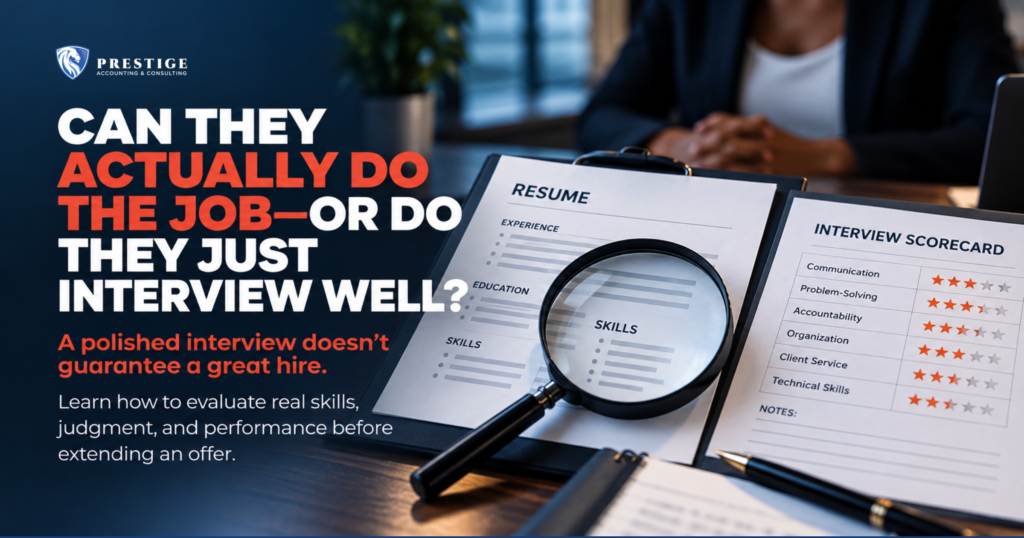
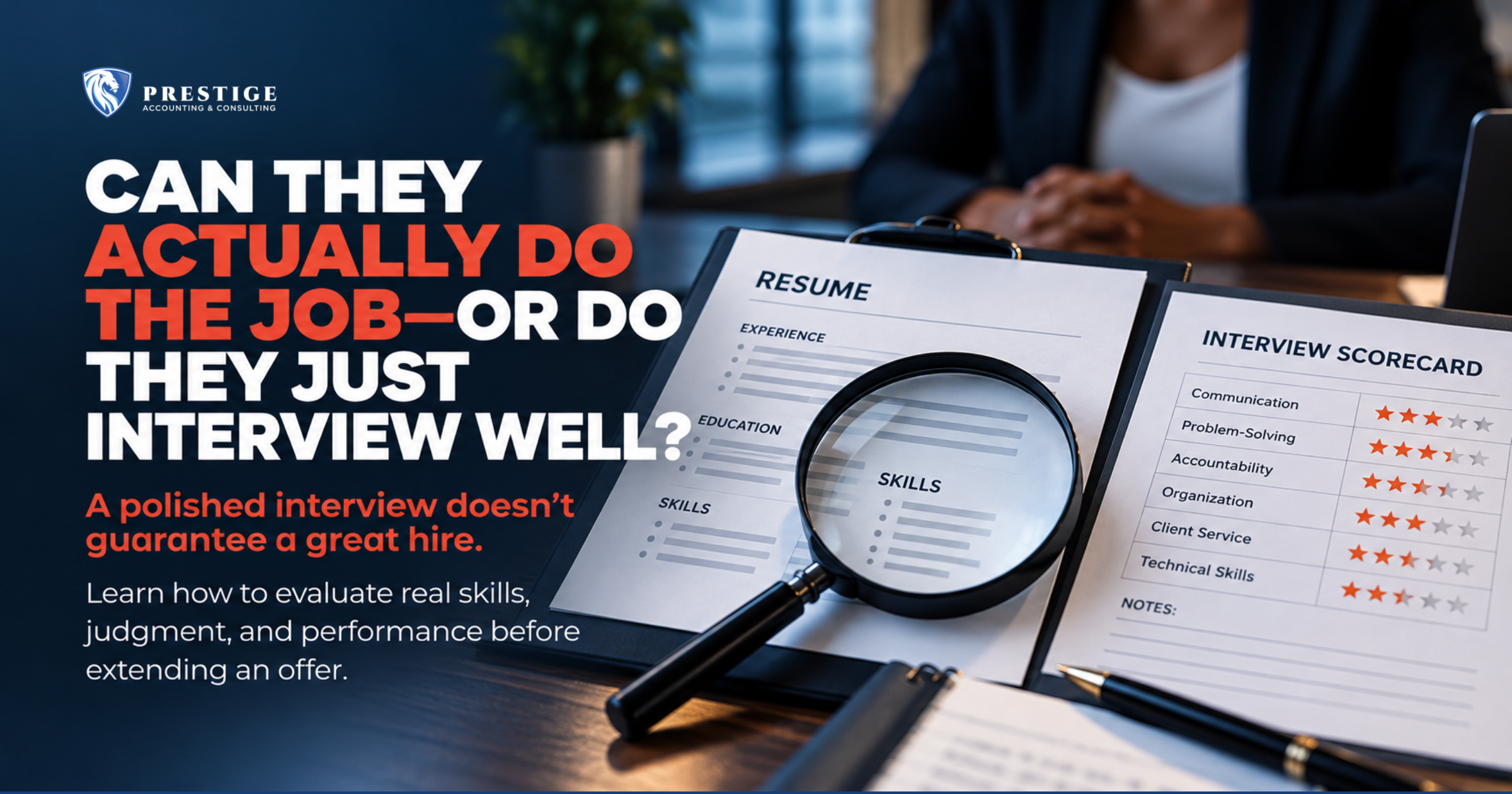
Create a Hiring Scorecard Before You Meet the Candidate
One of the simplest ways to reduce personality-driven hiring decisions is to decide what matters before the candidate walks into the room.
Create a scorecard for the position.
Depending on the role, your criteria might include:
Role-specific capability: Can they perform or learn the technical responsibilities?
Accountability: Do they demonstrate ownership of commitments and outcomes?
Communication: Can they communicate effectively with the people this role serves?
Judgment: Can they make appropriate decisions within the authority of the position?
Reliability: Do their examples demonstrate consistency and follow-through?
Problem-solving: How do they approach situations that don’t have obvious answers?
Coachability: Can they receive feedback and adjust?
Values alignment: Do their demonstrated behaviors align with how your firm expects people to work?
Have interviewers evaluate those criteria separately before discussing the candidate as a group.
That won’t eliminate subjectivity completely.
Hiring involves human judgment.
But it helps prevent one charismatic interview from overpowering the evidence.
Ask the Question That Matters Six Months From Now
Before extending an offer, imagine the candidate has been working at your firm for six months.
What will make you say:
“Hiring this person was the right decision”?
Will it be because they’re friendly?
Probably not.
You’ll likely say it because clients receive better service. Work moves without constant supervision. Deadlines are reliable. Attorneys have more capacity. The employee communicates clearly. Their manager isn’t constantly checking behind them. The team trusts them to do what they say they’ll do.
Now reverse-engineer your hiring criteria from that picture.
The qualities you’ll value six months after hiring should be the qualities you’re testing before the offer.
That simple shift can dramatically improve how law firm owners evaluate candidates.
Your Hiring Process Should Protect You From Your Own Biases
This is one of the reasons structured hiring matters.
We all naturally respond to people who feel familiar, communicate like us, share similar interests, or make conversations easy.
That doesn’t make someone a bad hiring manager.
It makes them human.
A structured process creates guardrails around those instincts.
Define the role before interviewing.
Use consistent core questions.
Ask for behavioral evidence.
Incorporate appropriate work samples.
Score candidates against predetermined criteria.
Check references thoughtfully.
Compare evidence before comparing personalities.
You can still trust your judgment.
You’re simply giving your judgment better information to work with.
Use the Smart Hiring Scorecard Before You Add Another Employee
Before evaluating who to hire, make sure you’ve answered an even earlier question:
Is your law firm actually ready to hire?
Prestige Accounting & Consulting created the Smart Hiring Scorecard for Law Firms to help owners evaluate the business behind a potential hire, including capacity, role clarity, financial readiness, systems, and expected outcomes.
It’s free, and it’s designed to help you determine whether another employee is truly the right solution before increasing payroll.
[Download the Free Smart Hiring Scorecard for Law Firms → LINK TO BE ADDED]
Once you’ve established that your firm is ready to hire, you can move from hiring readiness to building a stronger selection process.
Build a Hiring System That Goes Beyond Gut Feeling
For law firm owners who want to go deeper, The Million-Dollar Law Firm Hiring Playbook provides a broader framework for approaching hiring strategically rather than reactively.
It’s designed to help you think through the systems behind building a high-performing team—from defining what the firm needs and evaluating candidates to establishing clearer expectations around performance and accountability.
[Explore The Million-Dollar Law Firm Hiring Playbook → LINK TO BE ADDED]
And if you’re looking at your team and aren’t sure whether the problem is the people, the roles, the financial structure, or the systems supporting them, reach out to Prestige Accounting & Consulting. Sometimes the most valuable hiring decision is figuring out what your firm actually needs before you make it.
Final Thoughts
Personality matters.
You want people who communicate well, treat clients and coworkers respectfully, and contribute positively to the environment you’re building.
But personality alone doesn’t carry a caseload, follow through on commitments, protect client experience, create attorney capacity, or make your firm more operationally reliable.
Accountability does.
The strongest law firm hiring decisions aren’t based on choosing between personality and performance. They’re based on understanding which interpersonal qualities support the role while requiring evidence of the behaviors that actually produce results.
So the next time your team finishes interviewing a candidate and someone says:
“I really liked them.”
Don’t dismiss that reaction.
Just ask one more question:
“Great. What did we learn that makes us confident we can rely on them?”
The answer to that question will tell you much more about the person you’re actually considering hiring.