
Are You Hiring Because You Need Help—or Because Your Firm Is Actually Ready?
October 13, 2026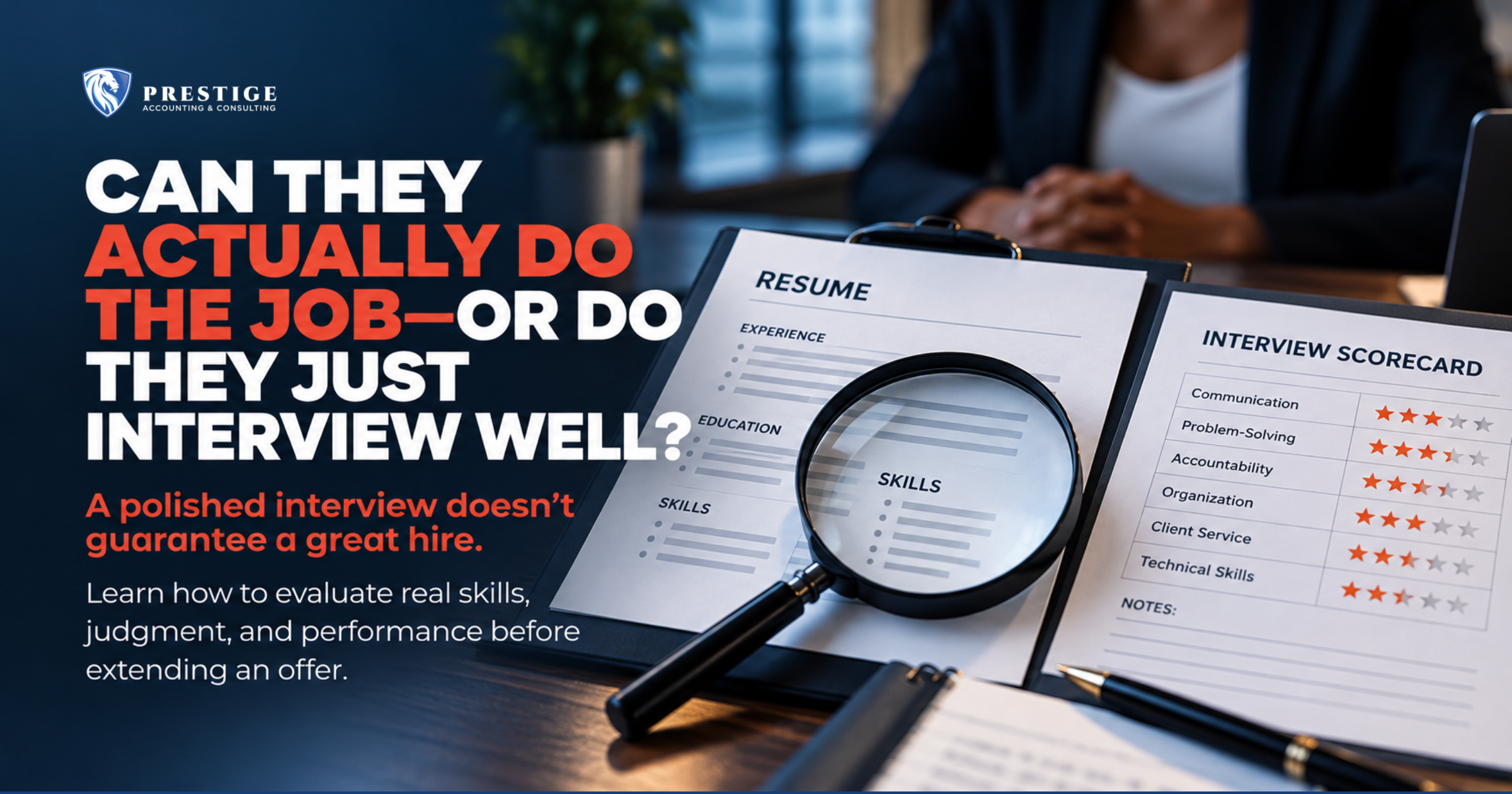
How to Tell If a Candidate Can Actually Perform—not Just Interview Well
October 20, 2026
3 Interview Red Flags Law Firm Owners Should Never Ignore
A candidate can interview extremely well and still become the wrong hire.
They may have the right legal experience, an impressive résumé, excellent references, and a polished answer for almost every question you ask. They may even have worked in another successful law firm with responsibilities that look nearly identical to the position you’re trying to fill.
Then they join your team.
Within a few months, deadlines require more supervision than expected. Feedback turns into defensiveness. Problems are consistently someone else’s fault. The employee can perform individual tasks, but struggles to take ownership of the outcome. Eventually, the law firm owner begins wondering how none of this appeared during the interview.
Sometimes, the warning signs were there. The interview simply wasn’t designed to uncover them.
For law firms, hiring requires more than determining whether someone can perform the technical responsibilities listed in a job description. Attorneys also need to evaluate how candidates think, communicate, respond to accountability, exercise judgment, and operate when instructions aren’t perfectly clear. Those characteristics become particularly important in an environment where mistakes can affect clients, deadlines, billing, team capacity, and the firm’s reputation.
Before extending your next offer, here are three law firm interview red flags worth examining much more carefully.
Red Flag #1: Every Previous Problem Was Someone Else’s Fault
Ask a candidate about a difficult situation at a previous job and listen carefully to where responsibility goes.
Perhaps a former manager was unreasonable. The team was disorganized. The technology didn’t work. Another employee failed to communicate. Clients were difficult. The training wasn’t sufficient.
Any one of those explanations could be completely legitimate. Workplaces have problems, and a candidate shouldn’t be expected to pretend otherwise.
The red flag appears when every story follows the same pattern: something went wrong, and the candidate played no role in what happened or what could have been done differently.
This matters because accountability is difficult to evaluate through hypothetical questions.
If you ask, “Do you take responsibility for mistakes?” almost every candidate knows the correct answer. Instead, behavioral interview questions force candidates to describe what they have actually done.
Try asking:
“Tell me about a mistake you made at work that affected someone else. What happened, and what did you do afterward?”
A strong answer doesn’t require a dramatic confession. What you’re listening for is whether the candidate can identify their own contribution to a problem, explain how they corrected it, and describe what changed afterward.
For example, perhaps a candidate missed an internal deadline because they underestimated how long a task would take. A thoughtful answer might explain that they notified the appropriate person, corrected the problem, and began using an earlier internal deadline or different tracking process to prevent it from happening again.
That answer demonstrates something more valuable than perfection.
It demonstrates self-awareness and corrective action.
Now compare that with a candidate who spends five minutes explaining why the deadline wasn’t really their fault.
That doesn’t automatically disqualify someone, but it deserves another question.
Why Accountability Matters More as a Law Firm Grows
A small law firm can sometimes compensate for weak accountability because the owner sees nearly everything.
As the team expands, that becomes impossible.
A managing attorney cannot personally verify every client communication, administrative task, billing entry, intake follow-up, or internal deadline. The organization increasingly depends on employees recognizing problems, communicating them promptly, and taking responsibility for correcting what falls within their control.
Without that culture, mistakes tend to move upward.
Employees wait for managers to identify problems. Managers spend their time checking work that should already be reliable. Attorneys become reluctant to delegate. Eventually, the owner becomes the quality-control system for the entire firm.
That isn’t scalable.
When interviewing candidates for a growing law firm, don’t simply ask whether they have made mistakes.
Find out what they do after one happens.
Red Flag #2: They Can Explain Their Tasks but Not Their Results
This is one of the most important distinctions law firm owners can make during an interview.
Ask a candidate about their previous role and you may hear an impressive list:
“I handled intake.”
“I managed the attorney’s calendar.”
“I prepared documents.”
“I followed up with clients.”
“I worked on billing.”
“I managed social media.”
Those answers describe activity.
They don’t necessarily describe performance.
A candidate may have completed a task every day without ever understanding whether that task produced the result the organization needed.
For example, an intake specialist might say they answered incoming calls. That’s useful information, but it doesn’t tell you whether they responded quickly, qualified prospects correctly, improved consultation bookings, maintained accurate records, or consistently followed up with leads.
A billing employee may have prepared invoices. But did invoices go out on time? Did billing errors decrease? Were accounts receivable monitored? Did their work help improve collections?
A marketing employee may have published content every week. But did they understand the firm’s target audience? Could they connect marketing activity to leads, consultations, or business development goals?
The stronger interview question is:
“How did your previous employer know you were doing a good job?”
Then stop talking.
The answer can tell you a great deal about how the candidate understands performance.
Someone who has worked in an accountability-driven environment may discuss measurable expectations, turnaround times, deadlines, client satisfaction, case progression, collections, conversion rates, accuracy, or other outcomes relevant to their position.
Someone who struggles to move beyond “I completed everything assigned to me” may be accustomed to measuring performance through activity rather than results.
That doesn’t necessarily mean the candidate cannot succeed. Their previous employer may simply never have established meaningful performance measures.
But it tells you something important about the management they may need.
Hire for Outcomes, Not Just Responsibilities
This is also where law firms need to examine their own hiring process.
If you want candidates to think in terms of outcomes, your job description and interview process should do the same.
Before interviewing anyone, determine what success in the position actually means.
For an intake specialist, success could include timely response, accurate qualification, strong consultation booking, proper CRM documentation, and consistent follow-up.
For a paralegal, it may include reliable case progression, deadline management, quality work product, appropriate client communication, and increased attorney capacity.
For billing and collections, success might involve timely invoicing, accurate billing, improved receivables management, and consistent collection procedures.
This creates a much stronger interview because you’re no longer trying to determine whether someone can perform a list of tasks.
You’re evaluating whether they can take ownership of a business outcome.
Red Flag #3: They Need Perfect Instructions Before They Can Move
This one requires nuance, particularly in a law firm.
Employees should not improvise legal advice, disregard established procedures, or make decisions outside the authority of their position. Law firms need clear processes, appropriate supervision, and careful escalation procedures.
But there’s an important difference between respecting boundaries and being unable to operate without constant direction.
Growing firms need employees who know when to follow the process, when to ask a question, when to escalate a risk, and when they already have enough information to take the next appropriate step.
You can test this during an interview with a scenario rather than a yes-or-no question.
For example:
“You’re working on an important assignment and realize you don’t have one piece of information you expected to receive. The attorney responsible is unavailable for the next two hours. Walk me through what you would do.”
There isn’t necessarily one correct answer.
You’re evaluating the candidate’s thought process.
Do they immediately stop working?
Do they guess?
Do they identify what can continue without the missing information?
Do they check available resources first?
Do they understand when the issue requires escalation?
Do they communicate the potential delay?
Do they document what they’ve done?
For client-facing positions, you can create a similar scenario involving an upset client. For intake, use a prospect who doesn’t fit the standard qualification process. For operations, present competing priorities. For billing, describe an unusual discrepancy.
The purpose isn’t to trick the candidate.
It’s to observe judgment under imperfect conditions.
Why This Matters for Owner Dependency
One of the biggest operational challenges in a growing law firm occurs when every unusual situation eventually lands on the owner’s desk.
The owner becomes the person who answers every question, approves every exception, resolves every conflict, and determines every next step.
Hiring more people doesn’t automatically solve that problem.
In fact, hiring employees who require constant direction can make owner dependency worse.
Now the owner has more people asking questions.
A strong employee doesn’t need to know everything. They need to understand how to think within the responsibilities and authority of their role.
That distinction becomes increasingly valuable as the firm grows.
Don’t Confuse Confidence With Competence
There is another reason these red flags can be difficult to identify during law firm interviews: interviewing itself is a skill.
Some candidates are excellent interviewers.
They’re personable. Confident. Quick with answers. They know how to build rapport and tell a compelling story.
Other highly capable candidates may be more reserved.
That’s why “I really liked them” should never be the primary hiring criterion.
Personal connection matters, particularly when you’re building a small team that works closely together, but it shouldn’t replace evidence.
Instead of evaluating candidates primarily on how impressive they sound, create opportunities for them to demonstrate how they think.
Ask for specific examples.
Ask follow-up questions.
Use realistic scenarios.
Ask what they learned.
Ask how success was measured.
Ask what they would do differently.
The deeper you go, the harder it becomes to rely exclusively on polished interview language.
Use the Same Core Questions With Every Candidate
Another way to improve law firm hiring decisions is surprisingly simple: add structure.
When interviews are completely conversational, candidates may end up being evaluated on different criteria. One interview focuses heavily on experience. Another becomes a discussion about personality. A third spends most of the time talking about the firm.
By the end, leadership is comparing impressions instead of comparable information.
Develop a core set of questions tied to the competencies the position requires and ask every serious candidate those questions.
You can still have a natural conversation and ask follow-ups. But having a consistent framework gives you better information to compare afterward.
For example, your interview scorecard might evaluate:
- Relevant experience
- Accountability
- Problem-solving
- Communication
- Judgment
- Role-specific knowledge
- Ability to receive feedback
- Ownership of outcomes
- Alignment with the firm’s working expectations
Then require interviewers to document evidence for their ratings.
“Great energy” isn’t evidence.
“Described a specific billing error, explained how she corrected it, and created a review checklist that prevented recurrence” is.
That is a much stronger basis for a hiring decision.
A Red Flag Is a Signal to Investigate, Not Always a Reason to Reject
One of the biggest mistakes employers can make is turning interview advice into rigid rules.
A candidate gives one imperfect answer and they’re immediately eliminated.
That’s not the purpose of identifying red flags.
A red flag tells you:
Ask another question.
If the candidate blames a former employer, ask what they would have done differently.
If they can’t explain how their performance was measured, ask what they personally used to determine whether they were succeeding.
If they appear dependent on detailed instructions, give them another scenario and see how they reason through it.
Patterns are much more informative than isolated answers.
Your goal isn’t to find a candidate who has rehearsed every “right” response.
It’s to gather enough evidence to make a thoughtful decision about whether this person can succeed inside your particular law firm.
The Interview Should Test the Job You’re Actually Hiring For
Before your next interview, look at the questions you’re planning to ask and compare them with the actual position.
If you’re hiring someone to manage competing deadlines, test prioritization.
If they’ll communicate with clients, test communication.
If the role requires independent decision-making, test judgment.
If they’ll be responsible for measurable outcomes, ask about past results.
If accuracy is critical, incorporate an appropriate skills assessment into your broader hiring process.
And if the position is being created to reduce the owner’s workload, pay particular attention to whether the candidate demonstrates the ability to take ownership within clearly established boundaries.
A résumé tells you where someone has worked.
A well-designed interview helps you understand how they work.
Before You Extend the Offer, Look at the Entire Hiring Decision
The interview is only one piece of a strong hiring process.
Law firm owners should also consider whether the position itself has been clearly designed, whether the firm’s systems can support the new employee, what performance expectations will be established, and whether the financial investment makes sense.
That’s why we’ve created the Smart Hiring Scorecard for Law Firms, a free worksheet designed to help law firm owners evaluate hiring readiness before adding another employee to payroll.
Use it alongside your interview process to assess whether the role, financial capacity, systems, expectations, and business need are aligned before you make the commitment.
[Download the Free Smart Hiring Scorecard for Law Firms → LINK TO BE ADDED]
The goal isn’t simply to avoid the wrong candidate.
It’s to create a hiring process that gives the right candidate a better opportunity to succeed.
Final Thoughts
Law firms cannot eliminate every hiring risk. People are complex, interviews are imperfect, and even a candidate who checks every box may ultimately not be the right fit.
But owners can make hiring substantially more intentional.
Pay attention when candidates consistently avoid accountability. Look beyond task lists and determine whether they understand outcomes. Test how they exercise judgment when the answer isn’t perfectly laid out for them. Most importantly, use follow-up questions and evidence instead of relying entirely on first impressions.
As your law firm grows, every new employee becomes part of the system supporting your clients, your attorneys, and your profitability.