
3 Interview Red Flags Law Firm Owners Should Never Ignore
October 15, 2026
Accountability vs. Personality: What Should You Really Look for When Hiring?
October 22, 2026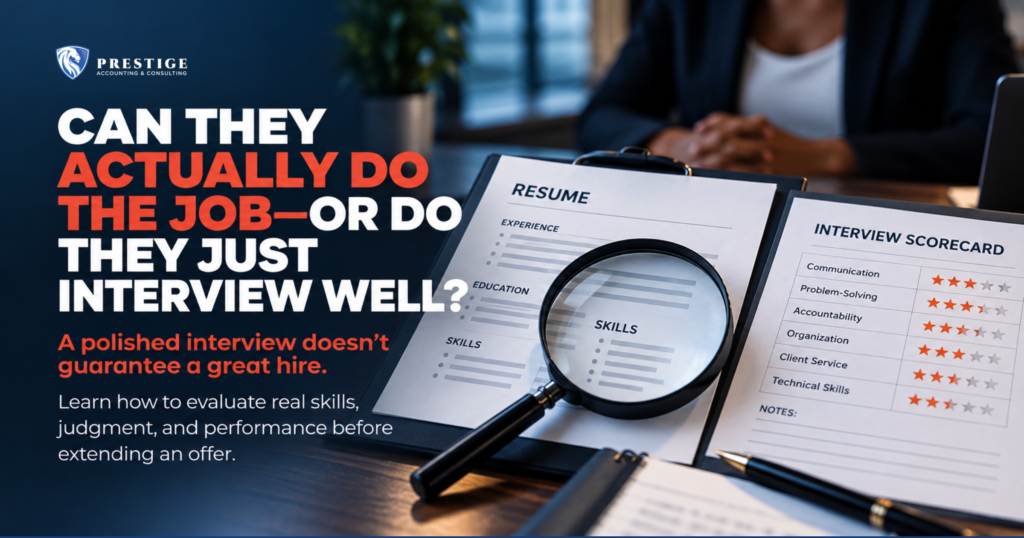
How to Tell If a Candidate Can Actually Perform—not Just Interview Well
You’ve narrowed 75 applications down to five candidates.
After several interviews, one person clearly stands out. They’re confident, personable, articulate, and prepared. They know exactly what to say when you ask about teamwork, accountability, deadlines, and client service. Everyone on the interview panel likes them.
You can already picture them on the team.
There’s just one problem:
Being good at interviewing and being good at the job are two completely different skills.
An interview gives law firm owners useful information, but it also creates an unusual environment. Candidates know they’re being evaluated. They prepare answers, research common interview questions, and naturally present the strongest version of their experience.
That’s not dishonest. It’s what interviews are designed to encourage.
The challenge for a law firm owner is figuring out what exists underneath the polished answers. Can this candidate manage competing deadlines? Communicate appropriately with clients? Take responsibility when something goes wrong? Produce accurate work? Solve problems without escalating every decision? Receive feedback without becoming defensive?
Those qualities are harder to evaluate through conversation alone.
A stronger law firm hiring process doesn’t ask leadership to become better at reading people. It creates opportunities for candidates to demonstrate the qualities the job actually requires.
Stop Asking Whether You “Liked” the Candidate
For small and boutique law firms, chemistry matters. When teams work closely together, no one wants to hire someone who creates unnecessary friction.
But “I really liked them” is one of the least reliable hiring metrics available.
Likeability can influence how we interpret everything else. Once someone makes a strong first impression, it’s easy to give more weight to their good answers and explain away weaker ones.
Instead, separate connection from evidence.
After an interview, don’t simply ask your team:
“What did you think?”
Ask:
“What evidence did we hear that this person can perform the outcomes this role requires?”
That creates a very different conversation.
Perhaps the candidate described managing 80 active matters while maintaining specific internal deadlines. Maybe they explained how they improved an intake workflow after noticing leads were being lost. Perhaps they gave a detailed example of catching an error before it affected a client and changing their process afterward.
Those are observable examples.
“Great personality” isn’t.
Start With What Successful Performance Actually Looks Like
It’s impossible to determine whether someone can perform if the firm hasn’t defined performance first.
Before interviewing candidates, identify the three to five most important outcomes of the position.
Not 25 responsibilities.
Outcomes.
Suppose you’re hiring an intake specialist. The job description might include answering calls, entering information into the CRM, scheduling consultations, and following up with prospects.
Those are activities.
Successful performance may look more like this: qualified leads receive prompt responses, prospect information is accurately documented, consultations are scheduled efficiently, follow-up occurs consistently, and attorneys receive the information they need before the consultation.
For a paralegal, success might involve matters progressing according to established workflows, deadlines being reliably managed, work product meeting quality standards, clients receiving appropriate communication, and attorneys gaining meaningful capacity.
For billing and collections, success might include accurate and timely invoices, consistent follow-up on outstanding balances, improved visibility into accounts receivable, and fewer billing-related client issues.
Once those outcomes are defined, your interview questions become substantially better because you’re evaluating candidates against the actual needs of the law firm, rather than against whoever happens to make the strongest impression.
Ask for Evidence, Not Adjectives
Consider this common interview question:
“Are you organized?”
What do you expect the candidate to say?
“No, actually, I’m a disaster”?
Questions like this invite candidates to describe themselves using desirable adjectives.
Organized.
Detail-oriented.
Proactive.
Hardworking.
A team player.
Good under pressure.
Those descriptions tell you very little unless the candidate can support them with evidence.
Instead of asking whether someone is organized, ask:
“Tell me about a time you were responsible for several competing deadlines. How did you determine what needed your attention first, and how did you make sure nothing was missed?”
Instead of asking whether they communicate well:
“Tell me about a time you had to communicate difficult or unexpected information to a client or colleague. How did you approach it?”
Instead of asking whether they take initiative:
“Tell me about a problem you noticed before anyone asked you to address it. What did you do?”
The difference is subtle but important.
You’re moving from “Tell me who you think you are” to “Show me how you’ve behaved.”
Listen for the Candidate’s Actual Contribution
There’s one word worth paying attention to during behavioral interviews:
“We.”
“We increased conversions.”
“We reorganized the department.”
“We created a new process.”
“We managed 150 cases.”
There is nothing wrong with teamwork. In fact, you want employees who understand how to collaborate.
But if every accomplishment belongs to “we,” you may leave the interview without understanding what the candidate actually did.
Follow up.
“What part of that were you personally responsible for?”
Or:
“What decisions did you make during that project?”
Or:
“If I asked your former manager what you contributed specifically, what would they say?”
You’re not trying to catch the candidate exaggerating.
You’re determining the scope of their actual experience.
Someone can work on a high-performing team without personally possessing all of the skills that made that team successful. That’s particularly important when hiring someone into a smaller law firm where they may have significantly more individual responsibility.
Give Candidates a Chance to Show You Their Work
One of the strongest ways to improve law firm candidate evaluation is to incorporate an appropriate work sample or practical exercise into the hiring process.
The key word is appropriate.
The assessment should resemble the work the candidate would actually perform and should be reasonable in scope. It shouldn’t become an opportunity for the firm to obtain free substantive work from applicants.
For an intake position, you might provide a fictional inquiry and ask the candidate to explain how they would handle it according to supplied guidelines.
For an administrative position, you could provide a fictional calendar conflict and several competing priorities and ask how they would organize the situation.
For a marketing role, you might provide a hypothetical practice area and ask the candidate to outline how they would turn one attorney insight into several pieces of educational content.
For an operations position, you might show them a simplified workflow with an obvious bottleneck and ask what questions they would investigate before changing it.
For roles involving written communication, a short fictional writing exercise can reveal far more than asking, “Would you say you’re a strong writer?”
The objective isn’t perfection.
You’re looking at how the candidate approaches the work.
What questions do they ask?
What details do they notice?
What assumptions do they make?
How do they organize information?
Do they understand when something should be escalated?
Can they explain their reasoning?
That’s performance evidence an ordinary interview may never uncover.
Test Accountability by Talking About Failure
One of the most valuable things you can learn about a candidate is what happens when they get something wrong.
Everyone makes mistakes.
In a law firm, the important questions are whether employees recognize mistakes, communicate them appropriately, correct what can be corrected, and learn from them.
Ask:
“Tell me about a professional mistake you’re comfortable discussing. How did you discover it, what did you do next, and what changed afterward?”
Listen to the entire story.
Strong accountability usually includes some combination of ownership, communication, corrective action, and learning.
A candidate doesn’t need to say, “Everything was entirely my fault.” Real workplace situations are often more complicated than that.
What matters is whether they can identify their responsibility within the situation.
Employees who can do that are much easier to coach because feedback doesn’t automatically become a debate about who is to blame.
Evaluate Communication for the Role You’re Filling
“Good communicator” means different things in different positions.
A client-facing intake specialist needs to communicate with empathy and clarity while also gathering necessary information.
A paralegal may need to explain status updates clearly while respecting the boundaries of their role.
An operations manager may need to communicate expectations internally, handle difficult conversations, and translate leadership decisions into actionable processes.
A billing employee may need to explain financial information without creating unnecessary confusion or tension.
So don’t evaluate communication solely based on whether someone is charming during an interview.
Test the communication the job actually requires.
If the position involves email, include written communication in the assessment.
If it involves explaining complex information, ask the candidate to explain something.
If it involves difficult conversations, use a hypothetical scenario.
If it requires frequent communication with attorneys, ask how they handle situations where priorities conflict.
Interview conversation measures one kind of communication.
Your firm may need several others.
Find Out How the Candidate Receives Feedback
Hiring someone talented who cannot receive feedback can become expensive quickly.
Processes change. Attorneys have preferences. New employees misunderstand expectations. Even experienced professionals need coaching when entering a different organization.
Ask candidates to describe meaningful feedback they’ve received.
Then listen for what happened next.
Did they change anything?
Can they explain why the feedback was useful?
Did they disagree, and if so, how did they handle that disagreement?
A candidate doesn’t have to agree with every manager they’ve ever had. Healthy professionals can disagree.
What you’re evaluating is whether feedback becomes information they can process or an immediate threat they need to defend against.
That distinction can significantly affect training, management time, and long-term team performance.
Score Candidates Before the Debrief Changes Your Mind
After several interviews, memories blur.
One interviewer loved Candidate A.
Someone else remembers Candidate B’s experience.
Candidate C sent an excellent thank-you email.
Soon, the hiring conversation becomes a debate about impressions.
A structured interview scorecard can help.
Before interviewing, decide which competencies matter for the role. Depending on the position, that might include accountability, communication, technical capability, problem-solving, judgment, organization, ownership, adaptability, and relevant experience.
Then have each interviewer score the candidate independently before discussing them with everyone else.
More importantly, require evidence.
Instead of:
Accountability: 5/5
Document:
Accountability: 5/5 — Candidate provided a specific example of a missed deadline, explained how they communicated it, corrected the issue, and changed their tracking process afterward.
Now your hiring decision has a record behind it.
This doesn’t remove judgment from hiring.
It makes judgment more disciplined.
Don’t Forget the Reference Check
By the time a firm reaches reference checks, leadership may already feel committed to the candidate.
That can turn the reference call into a formality.
Don’t waste it.
When appropriate and permitted, use references to validate important parts of what you’ve learned during the hiring process. Ask about the candidate’s responsibilities, strengths, communication, reliability, ability to receive feedback, and the environment in which they performed best.
If the candidate described a significant accomplishment during the interview, you may also be able to ask a former supervisor about the nature of their contribution.
The goal isn’t to search for something negative.
It’s to gather another source of information before making a meaningful investment.
A Better Hiring Process Uses Multiple Forms of Evidence
No single hiring tool can tell you everything.
A résumé shows experience.
An interview shows how someone communicates and describes that experience.
Behavioral questions reveal examples of past behavior.
Practical assessments demonstrate elements of performance.
References provide outside perspective.
A scorecard creates consistency across candidates.
Together, they create a much stronger picture than any one of them can provide alone.
Think about it the same way attorneys approach an important matter.
You wouldn’t make a major conclusion based on one piece of evidence if several relevant sources were available.
Your hiring decisions deserve similar discipline.
From Hiring Readiness to a Complete Hiring System
If you’re still determining whether your law firm needs another employee in the first place, start with our Smart Hiring Scorecard for Law Firms. This free worksheet helps owners evaluate capacity, financial readiness, role clarity, systems, and the business need behind a potential hire.
Download the Free Smart Hiring Scorecard for Law Firms → LINK TO BE ADDED
Once you’ve established that the firm is ready to hire, the next challenge is building a process that consistently helps you identify the right people.
That’s where The Million-Dollar Law Firm Hiring Playbook goes deeper.
The Playbook is designed for law firm owners who want a more intentional framework for building their team—from thinking through the position and evaluating candidates to creating clearer expectations around performance and accountability.
[Explore The Million-Dollar Law Firm Hiring Playbook → LINK TO BE ADDED]
And if you’re looking at your team and aren’t sure whether the issue is hiring, capacity, profitability, or the way responsibilities are currently structured, you can also reach out to Prestige Accounting & Consulting. Sometimes an outside business perspective can help identify the problem before you invest in the solution.
Final Thoughts
The best candidate isn’t necessarily the person who gives the best interview.
It’s the person who gives you the strongest evidence that they can succeed in the job you’re actually hiring them to do.
That means law firm owners need to look beyond charm and polished answers. Define successful performance before the interview begins. Ask candidates for examples rather than adjectives. Test relevant skills. Examine accountability. Evaluate the communication the position truly requires. Use structured criteria so every candidate is being measured against the same expectations.
None of this makes hiring risk-free.
But it gives you something much stronger than a gut feeling.
It gives you evidence.
And when you’re making a decision that will affect your payroll, clients, attorneys, culture, and the future capacity of your law firm, that’s exactly what you should be looking for.