Why AI Is the Future of Law Firm Marketing
July 2, 2026
Profit Pillars Preview: The AI Systems We’re Teaching in Panama
July 9, 2026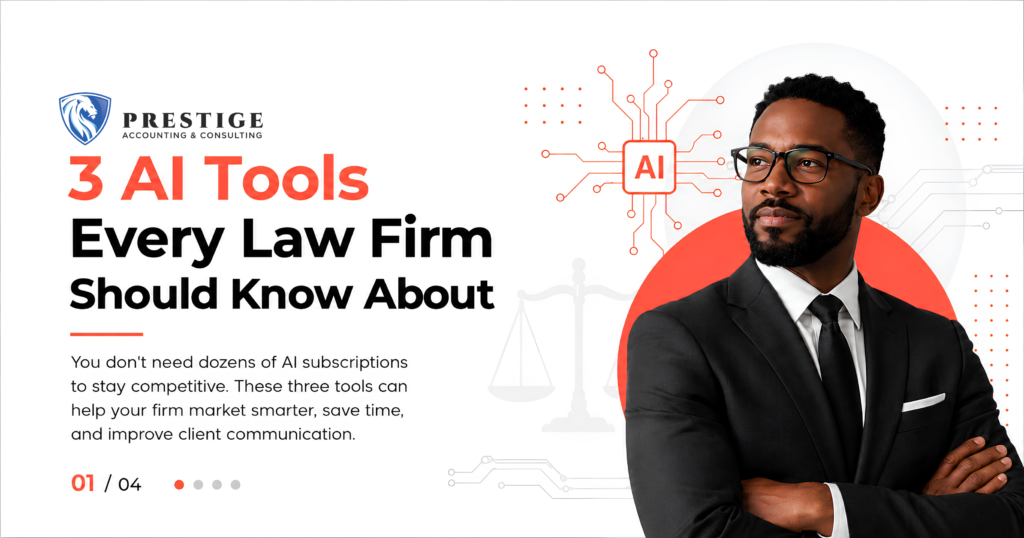
Artificial Intelligence has gone from being a trendy buzzword to becoming one of the biggest competitive advantages for modern law firms.
But here’s where many attorneys get stuck.
They hear about hundreds of AI tools every week.
One promises to write content.
Another promises to automate your office.
Another claims it will double your revenue.
Suddenly, instead of saving time, you’re spending hours trying to figure out which AI tools are actually worth learning.
Here’s the good news.
You don’t need 50 AI subscriptions.
In fact, if you’re just getting started, three well-chosen tools can completely change the way your firm markets itself, communicates with clients, and operates every day.
These are the three tools we believe every law firm owner should understand.
1. ChatGPT: Your Marketing & Brainstorming Partner
If you’ve ever stared at a blank screen wondering…
“What should I post on LinkedIn?”
“How do I write another newsletter?”
“What should my next webinar be about?”
…ChatGPT can become your marketing assistant.
Where ChatGPT shines
Instead of spending hours creating content from scratch, attorneys can use ChatGPT to:
 Brainstorm blog topics Generate social media captions Outline newsletters Draft webinar agendas Create podcast questions Rewrite complicated legal concepts into language clients actually understand Build FAQs for websites
The important thing?
Don’t let ChatGPT replace your expertise.
Let it eliminate the blank page.
Your experience, stories, and legal knowledge are what make the content valuable.
Practical Example
Instead of typing:
“Write me a blog.”
Try:
“Act as a marketing strategist for a family law firm in Atlanta. Write an outline explaining what happens during a divorce consultation using language that reduces fear and encourages potential clients to schedule an appointment.”
The quality of AI depends on the quality of your instructions.
2. Claude: The AI Every Law Firm Should Know About
While ChatGPT is excellent for creativity, Claude excels when you need depth, organization, and strategic thinking.
Think of Claude as the AI you bring into the conference room.
It’s particularly useful for attorneys because it can work through large amounts of information while maintaining context.
Where Claude shines
Law firm owners can use Claude to:
Build annual marketing plans Analyze business performance Organize operating procedures (SOPs) Review long documents Create educational presentations Build client onboarding workflows Develop strategic growth plans Turn rough notes into polished documentsOne of Claude’s biggest strengths is helping attorneys think through complex business decisions—not just generating text.
Practical Example
Imagine uploading:
- Marketing reports
- Website analytics
- Lead generation numbers
- Revenue by practice area
Instead of manually analyzing everything, you could ask:
“Based on this information, what are the three biggest marketing opportunities for my law firm during the next quarter?”
Within minutes, Claude can organize patterns that might take hours to identify manually.
3. Copy.ai: Your Follow-Up Machine
Many attorneys think marketing ends when someone fills out a contact form.
It doesn’t.
The follow-up process often determines whether that lead becomes a paying client.
That’s where Copy.ai can help.
Rather than focusing on long-form content, Copy.ai specializes in creating short-form marketing assets quickly.
Where Copy.ai shines
Email sequences Consultation follow-up emails Client onboarding messages Landing page copy Call-to-action variations SMS campaigns Google Ads headlines Facebook ad copyFor firms running multiple campaigns throughout the year, Copy.ai can dramatically reduce the time spent writing repetitive marketing copy.
Remember: AI Doesn’t Replace Strategy
One mistake many firms make is believing AI will automatically produce great marketing.
It won’t.
AI produces average results when given average instructions.
The firms seeing the biggest return on AI aren’t using better software.
They’re asking better questions.
They understand their ideal client.
They know their firm’s voice.
They have a clear marketing strategy.
AI simply helps them execute that strategy faster.
How These Three Tools Work Together
Here’s what a typical workflow could look like:
Step 1: Use Claude to build your quarterly marketing strategy.

Step 2: Use ChatGPT to create blogs, videos, podcast outlines, and educational content around that strategy.
Step 3: Use Copy.ai to write the emails, ads, landing pages, and follow-up campaigns that distribute your content and convert leads into consultations.
Instead of replacing your marketing team, these tools make your team significantly more productive.
AI Is a Competitive Advantage—If You Know How to Use It
The attorneys who benefit the most from AI won’t necessarily be the most tech-savvy.
They’ll be the ones willing to learn how to use it intentionally.
The goal isn’t to publish more content.
It’s to publish better content.
It’s not about automating relationships.
It’s about creating more time to build stronger ones.
That’s the real opportunity AI creates for law firms.
Final Thoughts
Technology is evolving quickly, but successful law firms don’t need to chase every new AI platform that appears.
Start with a few powerful tools.
Learn how they fit into your firm’s workflow.
Then build from there.
If you’re interested in seeing how attorneys are using AI to improve marketing, streamline operations, and create better client experiences, Profit Pillars was built to provide practical systems—not just theory.
And if you’d like help identifying where AI could make the biggest impact in your own firm, Prestige Accounting & Consulting offers complimentary consultations to help law firm owners build smarter, more efficient businesses.