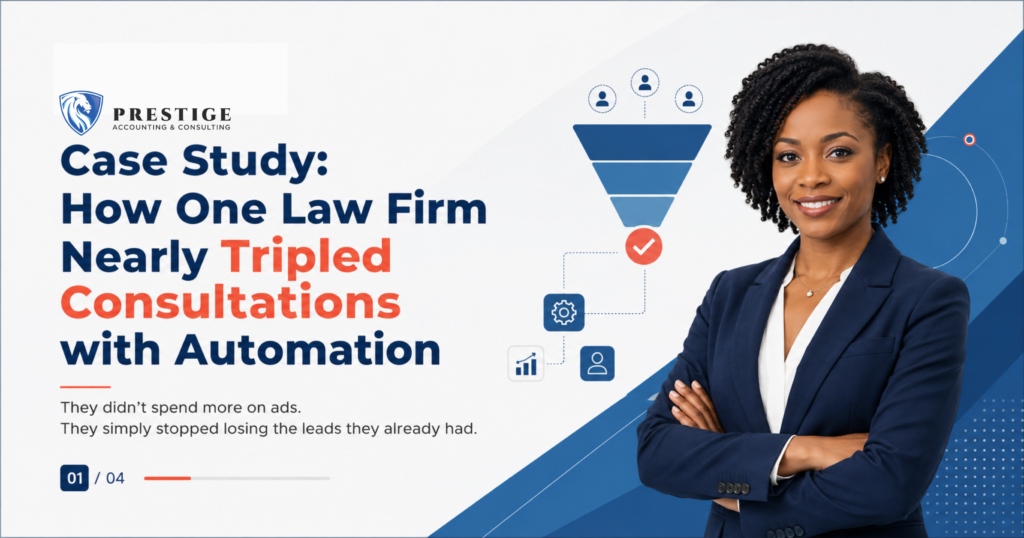
When we first met this law firm, they had a problem that many attorneys would actually consider a good problem.
They were generating leads.
People were visiting the website.
Consultation requests were coming in.
Referrals were steady.
On paper, everything looked healthy.
But behind the scenes?
The firm’s intake process depended almost entirely on one person remembering what needed to happen next.
If that person was busy…
Follow-up waited.
If they were in court…
Emails went unanswered.
If they took a day off…
Potential clients often disappeared.
The partners believed they needed more leads.
What they actually needed was a better system for managing the leads they already had.
The Challenge
Like many growing law firms, their marketing had evolved over time.
They had:
✔ Google Ads running.
✔ A professional website.
✔ Good online reviews.
✔ Referral partners.
✔ Social media activity.
The problem wasn’t attracting attention.
It was converting interest into consultations.
When we mapped their client journey, we discovered several gaps.
Potential clients would:
- Complete a website form…
- Wait several hours (or longer) for a response…
- Forget about scheduling…
- Contact another attorney instead.
Nobody intentionally ignored prospective clients.
The firm was simply relying on manual processes that couldn’t keep up with growth.
Looking at the Entire Client Journey
Instead of asking,
“How do we generate more leads?”
We asked a different question.
“What happens during the first seven days after someone contacts the firm?”
That simple exercise revealed opportunities everywhere.
There was no consistent follow-up.
No automated reminders.
No educational emails.
No process for re-engaging people who didn’t schedule consultations.
Every interaction depended on someone’s availability.
The System We Built
Rather than replacing the firm’s intake team, we focused on making their jobs easier.
The new client acquisition system included:
Immediate Lead Response
Every new inquiry automatically received:
- A personalized confirmation email.
- A text message acknowledging the request.
- Information about what to expect next.
Instead of wondering if their message had been received, prospective clients immediately knew someone would be contacting them.
Automated Consultation Scheduling
Rather than exchanging multiple emails trying to coordinate calendars, prospects could schedule consultations online.
Appointment confirmations and reminders were sent automatically.
This reduced scheduling delays while significantly decreasing missed appointments.
Educational Follow-Up
Not everyone hires an attorney the same day they make contact.
Some need time.
Others are comparing firms.
Instead of disappearing after the first interaction, the firm stayed connected through a series of educational emails covering:
- Frequently asked questions.
- What happens during the consultation.
- Client success stories.
- Resources related to their legal issue.
The goal wasn’t to pressure anyone into hiring the firm.
It was to build confidence.
Lead Tracking
Perhaps the biggest improvement wasn’t visible to clients at all.
For the first time, the firm could clearly answer questions like:
- Where did this lead come from?
- How long did it take to respond?
- Did the consultation get scheduled?
- Did the consultation become a client?
Instead of relying on assumptions, the partners had real data.
The Results
Within several months, the firm noticed meaningful improvements.
📈 Consultation requests that had previously gone cold were now consistently followed up with.
📈 More prospective clients completed the scheduling process.
📈 The intake team spent less time performing repetitive administrative tasks.
📈 Attorneys spent more time practicing law and less time chasing leads.
Most importantly…
The firm nearly tripled the number of completed consultations—not because they dramatically increased their advertising budget, but because they stopped losing opportunities that were already coming through the door.
Why Automation Worked
Many attorneys hear the word automation and assume it removes the personal touch.
The opposite happened.
Because repetitive administrative tasks were handled automatically, the firm’s team had more time for meaningful conversations with prospective clients.
Technology handled the routine work.
People handled the relationships.
That’s exactly how automation should work.
Could This Work for Every Law Firm?
Not every firm needs the exact same system.
A family law practice has different client expectations than an estate planning firm.
A personal injury practice follows a different intake process than a business litigation firm.
But every successful client acquisition system shares a few things in common:
✔ Quick response times.
✔ Consistent follow-up.
✔ Clear communication.
✔ Organized lead tracking.
✔ Simple scheduling.
✔ Educational content that builds trust.
Whether your firm receives ten leads a month or two hundred, those fundamentals don’t change.
Ask Yourself These Questions
Before investing more money in advertising, take a moment to evaluate your current process.
- How quickly does someone receive a response after contacting your firm?
- What happens if they don’t schedule a consultation?
- Do you know where your best clients come from?
- Are prospective clients receiving consistent follow-up?
- Could someone on your team explain your intake process without looking at notes?
If those questions are difficult to answer, your next opportunity may not be generating more leads.
It may be improving the system that manages the ones you already have.
Final Thoughts
The firms growing the fastest today aren’t always the ones with the biggest marketing budgets.
They’re the ones with the most consistent systems.
Small improvements in response time, follow-up, scheduling, and communication can dramatically improve how many consultations become paying clients.
If you’re wondering whether your firm’s intake process is helping—or hurting—your growth, Prestige Accounting & Consulting can help you evaluate your current marketing and client acquisition systems during a complimentary consultation. Sometimes the biggest opportunity isn’t finding more leads. It’s making sure you never lose the ones you’ve already earned.